
A Candid Interview with Marty Turcios - Not Only Does He Play, He Teaches
- Freelance Writer
- Oct 24, 2025
- 8 min read
Updated: Mar 8
Marty Turcios is the founder of Marty Turcios Therapeutic Golf. The first thing you’ll learn about Marty is that he doesn’t do small talk. At his Wednesday clinics, he’s more likely to hand you a club and say, “Let’s see what you’ve got,” than give a pep talk. But he does speak honestly about golf and disability. And if you want to know his philosophy on what it means to take ownership of your life, he will be happy to share that with you.
In this interview, Marty talks about the moments that shaped him and pushed him to start his nonprofit. He calls what he does Therapeutic Golf. For Marty, golf isn’t just a game: it’s a way to practice balance, problem-solving, patience, and sticking with something. He says golf helped him find his footing after tough times, and that’s why he teaches the way he does. Marty knows what it’s like to be underestimated. After talking with him, it’s clear that he’s also learned what it takes to “keep showing up”, no matter what.
This article is a summary of our conversation.
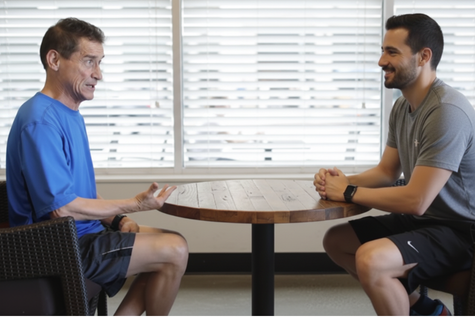
One on One with Marty
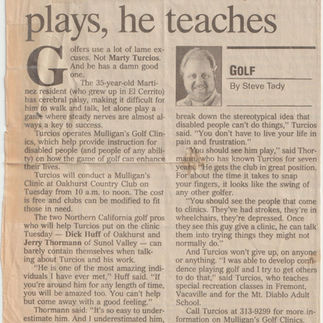
Interviewer: Marty, thanks for sitting down with me. I want to start with a headline from this newspaper back in 1994: “Golfer not only plays, he teaches.” What did that moment mean to you?
Marty: That story happened because a friend called up a sportswriter. Suddenly, people were reading about me in a way that caught them off guard. Most folks were surprised I could even play golf, never mind teach it. The funny thing is, I’d already been teaching since grade school. That part never made the headlines.
(Note: The newspaper article is attached below)
Interviewer: You were teaching golf in grade school? How did that come about?
Marty: I was in sixth grade at a private school for kids with orthopedic disabilities. One day at recess, I grabbed a couple of clubs and started showing my best friend how to hold one. My teacher overheard us and called out, “Marty, that’s not the right grip!” I shot back, “I didn’t know you played golf!” She laughed and said she didn’t, but her dad did. That moment stuck with me. It made me realize how quick people are to assume that if they can’t do something, I can’t either. That was really the start of a long, uphill climb for me.
Interviewer: When you say ‘uphill climb,’ what do you mean? Was it school, golf, work, or everything?
Marty: Honestly, it was all of it. School was tough. I had a hard time with classes, and I got sent to the lowest-performing high school in the district because my parents were told I “probably wouldn’t make it” anywhere else. It always felt like people expected me to fail, or maybe even wanted me to. That’s a belief I had to push back against again and again.
Interviewer: Yet you went on to earn both a bachelor’s and a master’s degree. What changed?
Marty: Funny enough, high school turned out to be some of the best years I had. I made friends who helped me get through the tough classes, and I taught them golf in return. I got involved with sports, not as a player, but as an equipment manager and assistant coach. I even lettered in football, basketball, and baseball. That’s when I started to see I had more to give than people expected. Those years taught me how to adapt, how to work hard, and those lessons are what got me into college.
Interviewer: Did that same connection through golf continue into college?
Marty: It did, but college was a whole new ballgame. I wasn’t ready for the workload or the pace; fifteen credit hours felt like a mountain, and nothing in my past had prepared me for it. I was in over my head until my major professor pulled me aside. He told me I had what it took to make a real difference in Recreation Therapy. He didn’t go easy on me, but that’s when things finally started to click.
Interviewer: For people who don’t know the field, what is Recreation Therapy? And what about it clicked for you?
Marty: Recreation Therapy is a mix of physical and occupational therapy with adaptive PE, but it’s about a lot more than that. At its heart, it’s about self-actualization: helping people build a mindset that’s self-driven, not boxed in by what others expect. It’s about using leisure to help people grow and become more independent and in control of their lives. That idea just fit with how I’ve always tried to live.
Interviewer: Self-actualization isn’t a word most people use every day. What does it mean to you?
Marty: You’re right, it’s not a word you hear every day. For me, self-actualization is about realizing what you’re truly capable of, and then actually going for it. Looking back, my own journey started way back in grade school, even if I didn’t have the words for it then. The way I handled my struggles, and what I learned from them, is really the backbone of what I teach now.
Interviewer: Looking back, was there a specific moment when you first felt that sense of possibility for yourself?
Marty: There was, actually. When I was a kid, we lived near a golf course, and I’d go out by myself just to hit balls. I had to figure out how to keep my balance and build up enough strength to really hit the ball. Nobody was there telling me how to do it, and nobody was encouraging me to stay with it. As I got better, I started to feel like, “I can do this.” That sense of self-direction stuck with me. Golf didn’t just help my balance and posture on the course, it also it carried over into my everyday life. Knowing I could play, no matter what anyone else thought, gave me a kind of confidence and independence I hadn’t felt before.
Interviewer: You’ve been candid about the challenges along the way. Did that inner drive help you face other challenges?
Marty: Yes, but it didn’t mean things were easy. After college, I thought I’d be teaching at the San Francisco Recreation Center for the Handicapped, but I ended up just cleaning up most days. That was tough. Then I started competing in the National Games for Cerebral Palsy and got “discovered” by a coach of the California team, which was exciting at first. I played in charity tournaments and met some prominent people. But after a while, I felt more like I was being put on display than truly respected for my abilities. I lost my way for a bit and alcohol became a crutch. I had to start over and rebuild my life from the ground up.
Interviewer: How did you recover from that?
Marty: It took a while. I moved back home and just focused on putting my life back together. Within a couple of years, I had my first car, started feeling independent again, and found a new sense of purpose. I kept going back to the driving range; golf gave me that feeling of direction I’d been missing. Then out of the blue, I got a call offering me a job teaching golf at Fremont Adult School in California. That was my first real position as a golf instructor, and it changed everything.
Interviewer: What was that first teaching experience like, and how did it change everything?
Marty: If one could imagine a group of people in a classroom, looking at me, a guy who has trouble walking and talking, as somebody that is supposed to teach them how to play golf, well, you could feel the skepticism in the air.
But after seven weeks, we weren’t just a class anymore: we were a team. They went from doubting themselves and me to believing in what we could do together. For me, it was a turning point: I went from being a recovering alcoholic to a real golf instructor. That’s how it changed everything.
Interviewer: Eventually, you went on to start your own nonprofit in golf instruction. Was there a moment or experience that made you realize you wanted to take that step?
Marty: As I gained more experience, I started helping rehab centers and schools set up their own therapeutic recreation programs. Pretty soon, people were asking me to help create local golf programs for people with disabilities. What I noticed was, a lot of clinics focused on numbers, such as how many people showed up and how smoothly the event ran. But for me, it was always about what each person took away from the experience, and whether it made them want to come back. I know what it’s like to look for something that actually helps, and how powerful it is when an activity starts to feel like it’s yours. That’s why I wanted to build something that helped people grow and become independent through golf.
Interviewer: What does ‘becoming independent through golf’ look like in actual practice?
Marty: My approach is called Therapeutic Golf because my intention goes beyond teaching people how to hit the ball. I want to teach them how to go golfing. That means learning how to book a tee time, arrange transportation and get to the course, understand course etiquette, and use any adaptive equipment they need. A lot of people living with disabilities have never been shown those steps.
It takes time, but as people build confidence in the clinics, I’ll take them out on a real course, cover their cost, and play right alongside them. I want them to feel what real independence looks like. That’s when they’re truly learning to golf on their own terms. Golf is a bridge between therapy and living a fuller life.
Interviewer: Have you seen people go on to become independent golfers? And do they still come to your clinics?
Marty: Absolutely. A lot of my students now play on their own with friends or family, which is exactly what I hope for. Some still come back for a tune-up or just to say hello, and others send me messages about their latest rounds. Seeing that kind of growth, and knowing they’re out there enjoying the game on their own terms, never gets old for me.
Interviewer: Would you call that mission accomplished?
Marty: In some ways, it is. Our mission is to help people enjoy the game on their own terms and help them become more independent. But that independence also extends beyond golf. What really matters is seeing them take that same sense of independence and confidence into other parts of their lives, just like I’ve tried to do myself.
Interviewer: You’ve shared both professional insights and personal experiences. Is it fair to say that those two perspectives shaped the way you approach your work?
Marty: It's fair. I know what it’s like to face challenges and find confidence through golf, so I bring that understanding to every lesson. The fact is that self-actualization isn’t just a theory for me, it’s something that I’ve lived. That’s why I work to help others see what they’re capable of, because I’ve been there myself.
Interviewer: Who do you hope will connect with your message, besides the people who attend your clinics?
Marty: Well, golf has always been more than a sport to me. The message is in between what we see as challenges and opportunities, between what others expect and what you know you can achieve. The key is understanding that you are more capable than the world expects.
I spend time with college students who are learning about recreation therapy. For them, I think this work is an example of self-actualization in practice. And for golf instructors teaching adaptive golf, I hope they remember to focus on the therapeutic value of their instruction because it's also about helping people beyond golf.
Thank you to Marty for his candor and for all he continues to do to help others, both on and off the course.



Click to enlarge
About Marty Turcios
Marty Turcios, MS, is the founder of Marty Turcios Therapeutic Golf (MTTG), a nonprofit providing no-cost therapeutic golf clinics for people living with disabilities.
This article is provided for educational purposes.

